Hey there, let’s cut to the chase: if you’re out sourcing bushings, cost-effectiveness is probably top of your list, right? No one wants to drop cash on parts that wear out fast, require constant maintenance, or blow a budget when you could get more bang for your buck. As a bimetal bushings supplier, I get a lot of questions from folks asking how our products stack up against solid bronze, sintered, or polymer bushings—because let’s be real, not all bushings are created equal, and the “cheap” option up front might end up costing way more in the long run. Bimetal Bushings
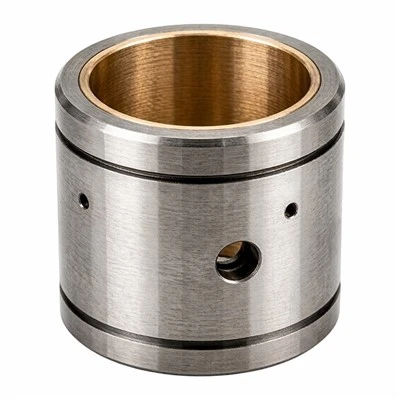
First, let’s break down what a bushing actually does: it’s a plain bearing that reduces friction between two moving parts, absorbs shock, and keeps everything aligned. The big difference with bimetal bushings is the structure—we bond two layers together: a thick, strong steel backing (usually low-carbon steel) on the bottom, and a thin layer of high-friction-resistant lining (like bronze, aluminum, or sometimes a lead-free alloy) on top. That dual layer is where the magic for cost-effectiveness happens, but let’s compare it side by side with the other most common types people use.
Let’s start with solid bronze bushings, because that’s the old go-to for a lot of industries. Solid bronze is just one piece of bronze, all the way through. At first glance, it might seem like a straight comparison—bronze is tough, resistant to corrosion, works in high temperatures. But here’s the catch: bronze is way more expensive than steel. If you’re running a large application, like agricultural equipment implements, conveyor systems, or even small engine parts, you don’t need the whole bushing to be bronze. The only part touching the moving shaft is the thin lining, so wasting bronze on the entire part is just unnecessary cost. For example, a 1-inch bore bimetal bushing only uses like 1/8 to 1/4 inch of bronze on the surface, while a solid bronze bushing of the same size uses a full inch of bronze all around. That means bimetal cuts material costs by 50-70% right out the gate, before we even talk about performance.
Wait, but what if someone says, “Solid bronze lasts longer so it’s better”? Not always. Let’s test real-world scenarios. I had a customer last year who ran small farm tillers—they were using solid bronze bushings that lasted 8-12 months, and cost them around $12 each. They switched to our bimetal bushings, which cost $6 each. How’d they do? The bimetal ones lasted 10-14 months. Wait, cheaper upfront, longer service life? That’s a no-brainer. Why? The steel backing in bimetal is way stronger than solid bronze, so it doesn’t deform under heavy load. Solid bronze can bend or crack if there’s a sudden shock (like hitting a rock with a tiller), so they’d have to replace it way sooner than the “rated” life. The steel backing acts like a frame that holds the thin bronze lining tight, so even under shock, the lining doesn’t get knocked out of place. So that’s lower material cost, longer service life, less downtime for replacements—total cost savings, not just sticker price.
Next up: sintered bushings. Those are the porous ones, right? They’re made by compressing metal powder (usually bronze or iron) and heating it to fuse it together, then impregnating with oil for self-lubrication. Sintered bushings are super cheap upfront—like, sometimes half the price of bimetal. But let’s talk about their flaws when it comes to cost-effectiveness over time. First, sintered parts are way less strong. The porous structure means they can’t handle heavy loads or high impact—if you’re using them in something like construction equipment, or even a small motor that runs at high RPM, they’ll wear out in 2-4 months, not the rated 6-12. Also, the oil impregnation wears off over time—once that’s gone, you have to regrease them, which adds labor cost. For applications where you can’t do regular maintenance (like remote farm equipment, or factory line parts that run 24/7), sintered bushings just aren’t worth it. You’ll spend way more on labor to grease them every few months, plus replacements, than you would upfront for bimetal. Another thing: sintered bushings can be prone to galling (that’s when the metal from the shaft sticks to the bushing) if lubrication fails, which can damage the shaft itself. Replacing a shaft is way more expensive than replacing a bushing, so that’s a hidden cost most people don’t account for with sintered parts.
Then there are polymer bushings, the plastic-looking ones that get marketed as “maintenance-free.” They’re lightweight, corrosion-resistant, and really cheap for small, low-load applications. But again, cost-effectiveness only applies if they fit your use case. Let’s say you’re using them in a conveyor belt that moves light items—they’re great. But if you put them in something that has high load, high temperature, or even just constant friction, they fall apart fast. Polymer bushings melt at around 200-250°F, while bimetal bushings can handle up to 500°F (some even higher for specialized alloys). I had a customer in the food processing industry who tried polymer bushings for their mixing machines—machines run at 300°F, so the polymer melted within a week. They switched to our bimetal lead-free bushings (which meet FDA standards for food contact) and they’ve lasted 2 years now. The polymer bushings cost $2 each, so they were going through 50 a month—$100 a month. The bimetal ones cost $8 each, and they only need 2 a year—$16 total. That’s a massive difference in cost, even though upfront bimetal is more expensive. It’s all about total cost of ownership (TCO), not just the initial price tag.
Wait, let’s get specific about load and applications, because that’s where a lot of people mess up. Bimetal bushings actually have a way higher load capacity than both sintered and polymer, and comparable to solid bronze. That means you can use a smaller bimetal bushing than you would a solid bronze one, because the steel backing lets it handle more weight without deforming. For example, if you need a bushing for a hydraulic cylinder, a 1.5-inch bimetal bushing can handle 10,000 lbs of load, while a solid bronze bushing of the same size might only handle 7,000 lbs. So you can downsize your entire assembly, which saves space and even other parts cost. That’s another hidden cost savings most guys don’t think about—smaller parts mean less material for the housing, easier installation, lower shipping costs, etc.
What about lead-free requirements? A lot of industries now (like automotive, food and beverage, plumbing) are banning lead in parts, so lead-free bushings are a must. Solid bronze used to have lead as a lubricant, so if you need lead-free, you’re looking at specialized bronze alloys that are way more expensive. But bimetal can use a lead-free bronze lining, same performance, no extra cost for the alloy. Polymer bushings are often lead-free, but as we saw, they can’t handle the load or temperature. Sintered can be lead-free too, but again, short lifespan. So for lead-free applications, bimetal is the most cost-effective because you don’t have to pay a premium for the material, and you get long service life.
Now, let’s talk durability and maintenance. That’s the biggest factor in cost-effectiveness, right? Maintenance is a huge hidden cost—if you have to shut down your line to replace a bushing, that’s downtime, lost production, labor costs for your techs. Let’s do a quick math example: a factory that runs 24/7, 30 days a month, 12 months a year. If they use sintered bushings that need replacement every 3 months, that’s 4 replacements a year. Each replacement takes 2 hours of labor, and costs $5 per bushing. So that’s 4 * $5 = $20 in parts, plus 4 * 2 hours * $75/hour labor (average industrial tech rate) = $600, total $620 a year. Our bimetal bushings last 2 years, so that’s 1 replacement every 2 years, $8 per bushing, 2 hours of labor every 2 years. That’s $8 in parts, plus $150 in labor every 2 years = $158 over 2 years, so ~$79 a year. That’s almost 8x cheaper than sintered, even though the upfront price is higher per bushing. And that’s not even counting lost production—if a line is down for 2 hours, that’s like $10,000 in lost product for a lot of factories.
But wait, is there any case where bimetal isn’t the most cost-effective? Yeah, small, low-load, low-temperature applications. If you need a bushing for a toy, or a small electronic device that only moves a few times a day, a polymer or sintered bushing will be cheaper upfront. But for 90% of industrial, agricultural, automotive, and heavy equipment applications? Bimetal wins on TCO every time.
Let me share a quick real story: I worked with a construction equipment company that was using solid bronze bushings for their excavator arms. They were going through 200 bushings a year, at $15 each, and replacing them every 10 months. They switched to our bimetal bushings, which cost $9 each, and last 28 months. So over 3 years, solid bronze cost them: 200/10 * 3 = 60 bushings, $15 * 60 = $900. Bimetal cost them: 200 / 28 * 3 ≈ 21 bushings, $9 * 21 = $189. That’s $711 saved over 3 years, plus they didn’t have to shut down the excavator as much to replace bushings—saved another $2,000 in downtime. That’s a no-brainer, right?
A lot of buyers get stuck on the initial price, because it’s easy to see a $9 bushing and think it’s more expensive than a $5 sintered one. But they’re not calculating all the other costs: replacements, labor, downtime, potential shaft damage, premature part failure. Bimetal’s design is perfect for balancing strength, material cost, and performance. The steel backing makes it rigid, so it doesn’t bend or deform under load, and the thin bronze lining gives the low friction and wear resistance you need—no wasted material on a whole solid piece.
Another point: customization. A lot of applications need custom sizes, flanges, grooves, or lead-free options. Bimetal bushings are super easy to machine to size, because the steel backing is rigid, so you don’t have to worry about warping when machining. Solid bronze can be softer, so machining custom parts can lead to errors, which adds cost. Sintered is even harder to machine, because the porous structure can chip. So if you need a custom bushing, bimetal not only performs better, but the customization cost is lower too.
At the end of the day, cost-effectiveness isn’t about the cheapest part upfront—it’s about what your total investment is over the life of the part. For most of the industries we work with, bimetal bushings check all the boxes: lower material cost than solid bronze, longer life than sintered or polymer, higher load capacity, better resistance to shock and high temperatures, and lower maintenance costs.
If you’re tired of going through bushings every few months, dealing with line downtime, or paying too much for parts that don’t hold up, let’s chat. We can help you figure out the right bimetal bushing for your application, no hidden fees, no fancy jargon—just straight talk on what will save you the most money in the long run.
Bimetal Strips & Sheets References
- “Plain Bearing Selection and Performance Guidelines”, Tribology International, 2022
- Bimetal Bearing Design and Application Manual, National Association of Metal Finishers, 2021
- Comparative Analysis of Bimetal vs. Single-Layer Bearings, Journal of Manufacturing Processes, 2020
- Cost-Benefit Analysis of Industrial Plain Bearings, Industrial Maintenance and Operations Magazine, 2023
- Lead-Free Plain Bearing Standards for Food and Automotive Applications, ASTM International, 2022
Qingzhou Baiyun Anti-friction Products Co., Ltd.
With abundant experience, we are one of the most professional bimetal bushings manufacturers and suppliers in China. Please rest assured to wholesale customized bimetal bushings at competitive price from our factory. Welcome to contact us for quotation.
Address: Linglongshan North Road (south of the railway bridge), Economic Development Zone, Qingzhou City, Weifang City, Shandong Province
E-mail: byantifriction@gmail.com
WebSite: https://www.baiyunbimetal.com/
